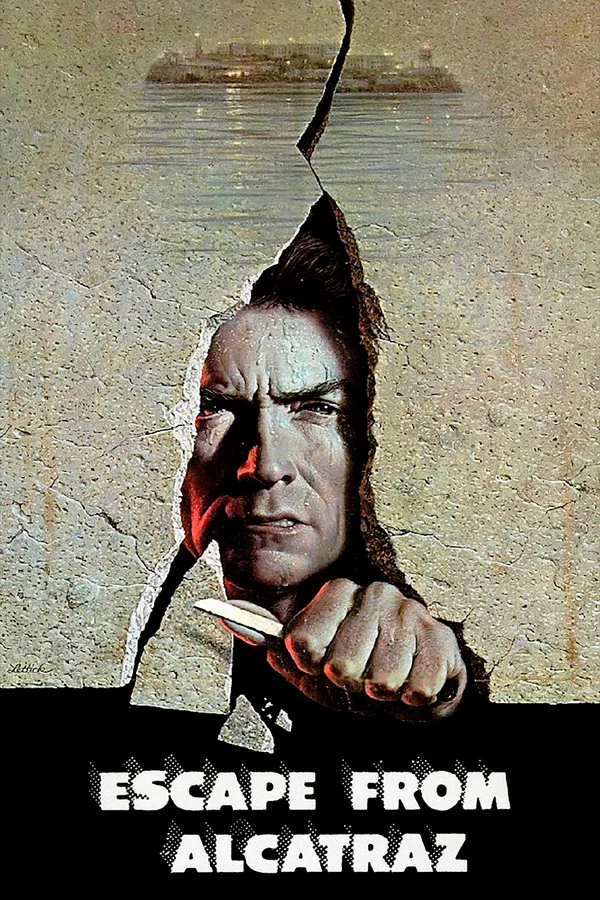
1979 • Clint Eastwood, Patrick McGoohan
Summary
Escape from Alcatraz follows the real-life 1962 escape attempt by Frank Morris and brothers John and Clarence Anglin from the maximum-security prison known as “The Rock.” The film details their ingenious plan: digging through concrete cell walls with improvised tools, creating realistic dummy heads from soap and stolen hair to fool guards, building a raft from raincoats, and slipping into the icy waters of San Francisco Bay on the night of June 11, 1962.
Dramatizations & Historical Liberties
1. The hidden workshop and tool fabrication
The movie shows a relatively streamlined process of drilling through cell walls with spoons and a homemade drill made from a vacuum cleaner motor. In truth, the preparation was far messier: they created a secret workshop area, hid debris in their cells and clothing, and improvised extensively. The film simplifies the enormous risk and patience required.
2. Personal conflicts with the warden and guards
The stern, intellectual warden (Patrick McGoohan) is a composite/fictionalized character. Many of the tense, personal confrontations and psychological power struggles are dramatized for cinematic effect. Real-life interactions were more institutional and less individualized.
3. Character portrayals and leadership roles
The film centers Frank Morris as the clear mastermind. Family accounts and some evidence suggest John Anglin played a larger role in planning and leadership than depicted. Supporting inmates (like Doc and English) are composites or have amplified personalities and backstories for emotional depth and moral contrast.
4. The escape night and bay crossing
The final sequence heightens suspense with dramatic lighting, close calls, and visual tension. The real escape involved climbing a ventilation shaft, navigating the roof, scaling a fence, and launching into extremely cold, current-swept waters — conditions even more perilous than shown. The film also stylizes the raft deployment and departure.
5. The ambiguous ending and survival implications
The movie ends on a poetic, open-ended note that subtly leans toward possible survival. Officially, the FBI concluded the men most likely drowned. However, the film (and ongoing debates) leave room for the theory they made it — a theory bolstered by later letters, family claims, and circumstantial evidence suggesting they reached Brazil or elsewhere.
Related
