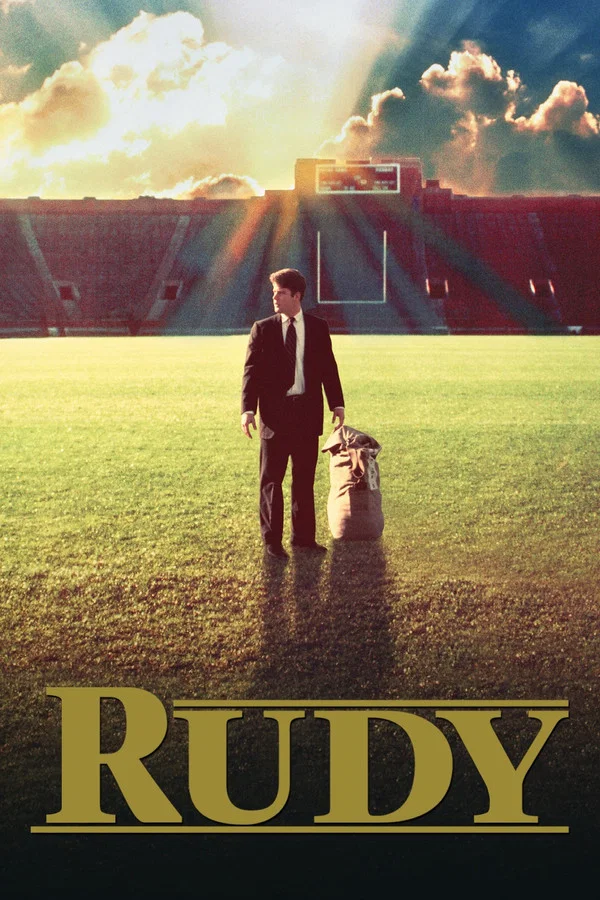
1993 • Sean Astin, Ned Beatty
Summary
Rudy tells the story of Daniel “Rudy” Ruettiger, a small-statured working-class young man with a lifelong dream of playing football for the University of Notre Dame. Despite lacking the size, athletic talent, and academic qualifications, Rudy overcomes repeated rejections, financial hardship, and self-doubt through sheer determination and relentless perseverance to earn a spot on the team.
Dramatizations & Historical Liberties
1. “Rudy! Rudy!” stadium chant
The film builds to an emotional climax where the entire Notre Dame stadium erupts in a thunderous “Rudy! Rudy!” chant as he is carried off the field on his teammates’ shoulders. In reality, this never happened. The crowd did not chant his name, and he was not carried off the field in a triumphant celebration.
2. Dramatic final-game sack
The movie portrays Rudy’s sack on the final play as a heroic, game-changing moment that seals a dramatic victory. In reality, while Rudy did participate in a sack on the last play of the game (shared with teammate Jay Achterhoff), Notre Dame was already leading comfortably 24-3. The play had no impact on the outcome, and the moment was far less climactic and heroic than the emotionally charged scene depicted in the movie.
3. Timeline compression and academic journey
The film condenses Rudy’s multi-year struggle — including years at Holy Cross, repeated rejections from Notre Dame, and his academic challenges — into a much tighter and faster-paced narrative. His real path involved far more persistence, repeated setbacks, and longer periods of hardship than the movie portrays.
4. Composite characters and team hostility
Several teammates and coaches are composites or have their personalities significantly altered. The film heightens bullying, locker-room hostility, and skepticism toward Rudy for dramatic conflict. While some players were initially doubtful of his abilities, many actually respected his work ethic and determination in real life.
5. Emotional underdog arc
The movie amplifies Rudy’s isolation, constant rejection, family struggles, and emotional lows to create a more powerful inspirational journey. While his story is genuinely remarkable, the film smooths over some of the messier personal details, family tensions, and everyday realities, presenting a cleaner and more emotionally manipulative underdog narrative.
Related