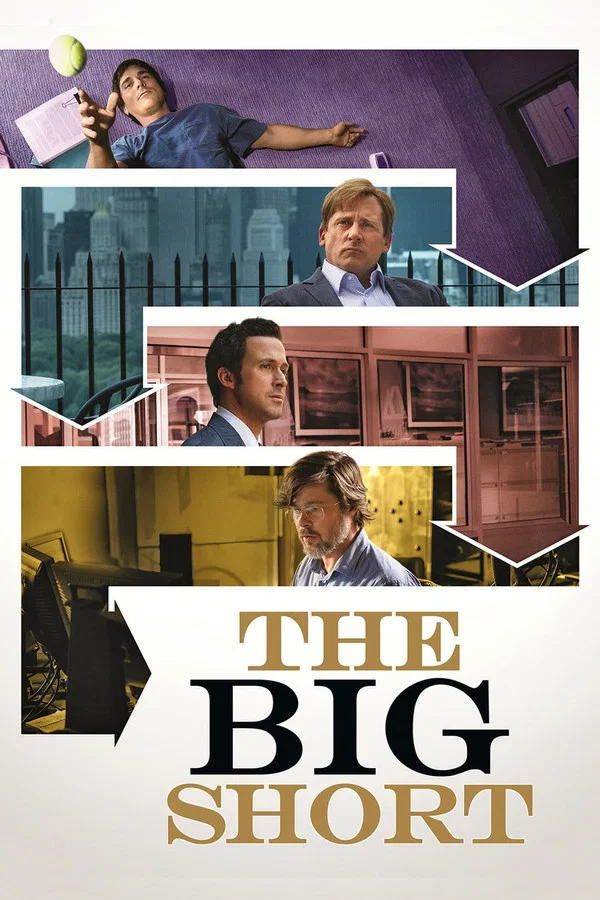
2015 • Christian Bale, Steve Carell, Ryan Gosling
Summary
The Big Short tells the story of a handful of contrarian investors who saw the impending collapse of the U.S. housing market and bet against it — ultimately profiting from the 2008 financial crisis. The film does an impressive job breaking down complex financial instruments like subprime mortgages, CDOs, and credit default swaps for a general audience.
Dramatizations & Historical Liberties
1. Celebrity fourth-wall explanations
The film frequently breaks the fourth wall with celebrity cameos (Margot Robbie in a bathtub, Selena Gomez at a blackjack table, Anthony Bourdain explaining CDOs with fish stew) to simplify complex financial concepts. While entertaining and effective for audience understanding, these scenes are entirely invented devices created by Adam McKay and did not occur in real life.
2. Multiple main characters are composites
Several key characters are composites or heavily altered. “Mark Baum” (Steve Carell) is primarily based on Steve Eisman but includes traits from others. “Jared Vennett” (Ryan Gosling) is largely based on Greg Lippmann but is a composite. This blending simplifies and dramatizes real people for narrative clarity.
3. Timeline compression and reordered events
The film heavily compresses the multi-year period (roughly 2005–2008) leading up to the financial crisis. Key warnings, critical meetings, major market shifts, and important personal developments are combined, shortened, or reordered to create a faster-paced, more cinematic narrative, which simplifies the complex, gradual buildup of the housing bubble.
4. Heightened personal struggles and emotional meltdowns
The movie significantly amplifies internal team conflicts, emotional outbursts, and personal crises — especially within Mark Baum’s (Steve Eisman) group — to heighten dramatic tension. While the real investors did face enormous stress and frustration, many of the specific heated arguments, breakdowns, and emotional confrontations shown on screen were invented or dramatically exaggerated for cinematic effect.
5. Overly simplified “good guys vs. system” framing
The film presents a clear moral narrative of a small group of heroic contrarians bravely fighting against a corrupt and greedy financial system. In reality, the situation was far more morally complex. Some of the real investors also profited handsomely from the very system they criticized, and the movie downplays the nuanced ethical gray areas, including how deeply intertwined many players were with the flawed system.