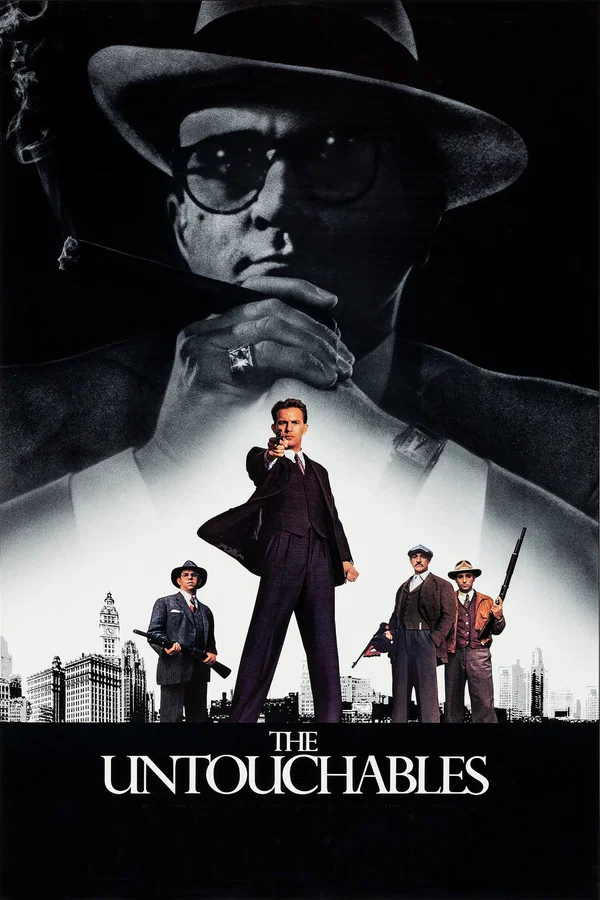
1987 • Kevin Costner, Sean Connery
Summary
The Untouchables follows Eliot Ness, a determined and incorruptible federal agent in 1930s Chicago, who assembles a small elite team to take down the powerful and ruthless crime lord Al Capone. The film depicts their intense battle against organized crime, bootlegging, and widespread corruption during the height of Prohibition.
Dramatizations & Historical Liberties
1. The famous courthouse stairs shootout
The film features one of its most iconic sequences: a slow-motion, highly stylized gun battle on the steps of the courthouse, complete with a baby carriage dramatically rolling down the stairs. This entire scene is completely fictional. No such large-scale, cinematic shootout ever took place during Eliot Ness’s investigation of Al Capone.
2. Composite characters and the small “Untouchables” team
The movie reduces Eliot Ness’s real team of roughly 12–15 agents into a tight, memorable squad of just four main characters. Sean Connery’s Jimmy Malone, in particular, is a heavily fictionalized composite character. His colorful personality, tragic backstory, and role as Ness’s wise, street-smart mentor were largely invented to give the story more emotional weight and dramatic focus.
3. The “The Chicago Way” speech and motivational moments
Many of the film’s most memorable and quotable lines — including the famous “They pull a knife, you pull a gun… That’s the Chicago way” speech — were written by screenwriter David Mamet. These powerful motivational moments did not come from the real Eliot Ness or his agents and were created to heighten the film’s dramatic and thematic impact.
4. Heightened personal revenge and graphic violence
The movie portrays Eliot Ness as far more vengeful, ruthless, and personally violent than historical accounts suggest. In reality, Ness ran a relatively disciplined operation focused primarily on building a strong tax evasion case against Capone rather than engaging in the bloody, personal gunfights and revenge-driven confrontations shown on screen.
5. How Capone was convicted
The film strongly implies that Eliot Ness and his Untouchables were the main heroes who brought down Al Capone through daring raids and shootouts. In reality, Capone was ultimately convicted on federal tax evasion charges through the meticulous, long-term work of IRS agents and federal prosecutors — not through the dramatic street battles and raids depicted in the movie.