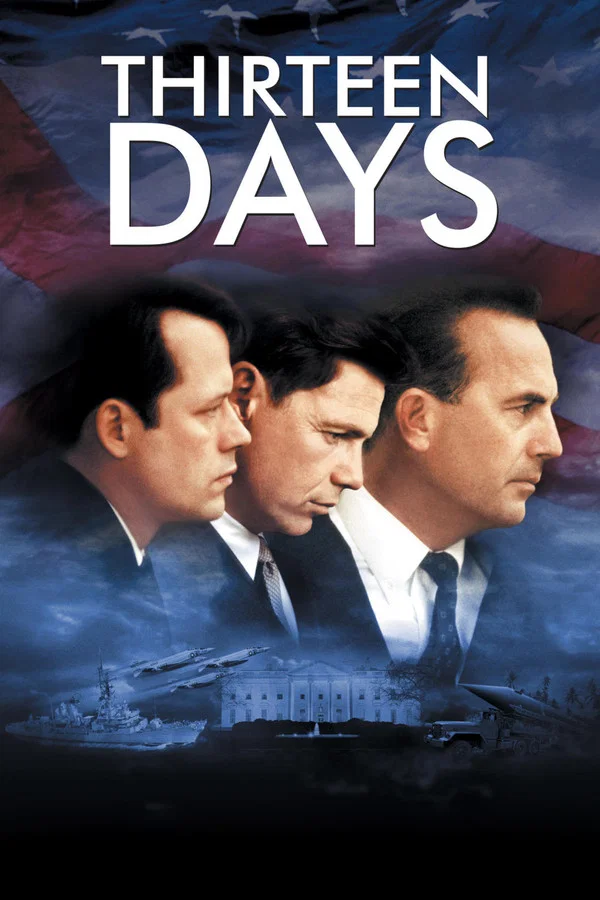
2000 • Kevin Costner, Bruce Greenwood
Summary
Thirteen Days dramatizes the 1962 Cuban Missile Crisis, the most dangerous confrontation of the Cold War. The film follows President John F. Kennedy and his inner circle in the White House as they grapple with the discovery of Soviet nuclear missiles in Cuba, navigating an intense 13-day standoff that brought the United States and the Soviet Union to the brink of nuclear war.
Dramatizations & Historical Liberties
1. The inflated role of Kenny O’Donnell
The film gives O’Donnell an expanded role as a key strategist and influential advisor who frequently steers President Kennedy’s decisions. In reality, while O’Donnell was a close aide and political operative, he was not nearly as central to the crisis deliberations as the movie suggests.
2. Heightened confrontations in the ExComm meetings
The movie dramatizes the high-stakes meetings of the Executive Committee (ExComm) with frequent emotional outbursts, personal clashes, raised voices, and intense confrontations between military “hawks” and diplomatic “doves.” While genuine tension, exhaustion, and sharp disagreements existed, the actual meetings were generally more measured, bureaucratic, and professional than the theatrical arguments frequently shown on screen.
3. The U-2 pilot incident and Soviet submarine close call
One of the most dangerous moments of the crisis — when a Soviet submarine (B-59) surrounded by U.S. Navy ships came extremely close to launching nuclear torpedoes — is largely minimized or omitted. The film focuses heavily on the downing of the U-2 spy plane but significantly downplays this terrifying incident, which brought the world closer to nuclear war than almost any other event during the 13 days.
4. The secret Turkey missile deal
The critical behind-the-scenes concession — the United States secretly agreeing to remove Jupiter missiles from Turkey to help Khrushchev save face and end the crisis — is noticeably softened or downplayed. The film emphasizes American strength and resolve while understating this important compromise, which was a key factor in resolving the standoff.
5. Timeline compression of the 13 days
The intense 13-day crisis is condensed into a tighter, more fast-paced narrative. Multiple critical meetings, intelligence updates, diplomatic cables, internal Soviet deliberations, and shifting positions are shortened, combined, or reordered to maintain dramatic momentum, making the events feel more linear and urgent than the often chaotic and exhausting reality.